
|
Partner Integration Spotlight
— Three “What If” Decisions for a Retired Couple’s IRA — — A Case Study Built in Wealthy and Wise+™ — |
A Note from Gonzalo M. Garcia, CLU: Disinheriting the IRS
This Blog shows how Wealthy and Wise+ lets an advisor change one decision at a time and show a client the impact.
The case is a healthy, retired couple who will never spend their IRA. The decisions are whether to accelerate IRA distributions, whether to buy second-to-die insurance with the proceeds, and where the IRA should go at the second death.
With permission, we’re pleased to share this article from Gonzalo M. Garcia, CLU, Chief Advanced Markets Officer at SPG Life & Annuity | HUB International. Presentations in this Blog were created using Wealthy and Wise+™.
The Question Nobody Asks
Every affluent IRA owner who won't spend the account has already answered this question, usually without knowing it was asked:
“When leaving an inheritance to your children, would you rather pay the tax on the assets that pass to them, or have them pay the tax?”
By default, the industry answers for the client: defer, take the RMD, and leave the rest. That is sound advice for the retiree who will spend the money. For the couple whose IRA has become a wealth transfer asset, it makes the IRS an unnamed beneficiary. Under the SECURE Act, most non-spouse beneficiaries must empty an inherited IRA within 10 years, usually in their peak earning years.
The One Big Beautiful Bill Act made the $15 million federal estate tax exemption permanent, and this couple is well inside it. Their problem is income tax, not estate tax.
A client rarely changes course because an advisor says “defer isn't always right.” They change when they see their own numbers move. That is what Wealthy and Wise+ does best: take one decision, change it, and show the do-it-versus-don't-do-it result side by side.
Case Study
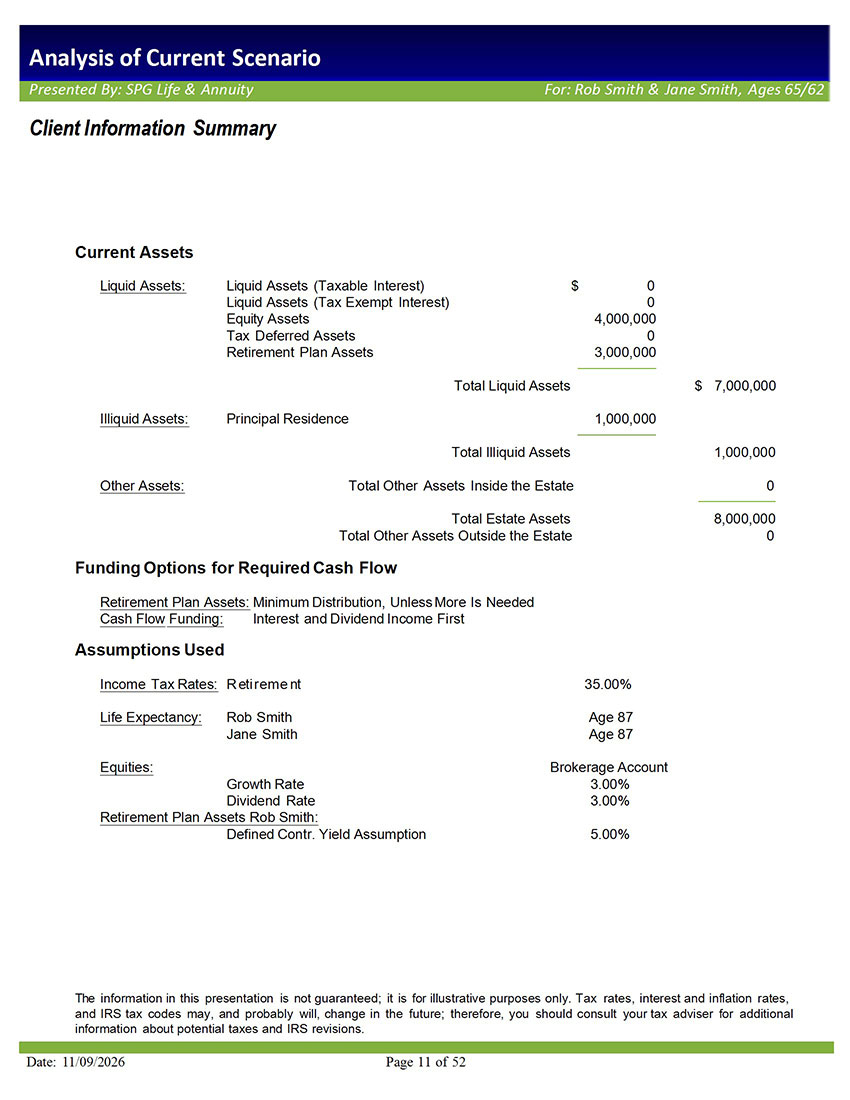
Rob Smith, age 65, has just sold his company for $3,000,000 net, and he and his wife Jane, age 62, are retiring. The proceeds went into their investment account. Below are the details of the data used in the evaluation:
- IRA (Rob): $3,000,000, yield 5.00%.
- Investment account: $4,000,000, including the sale proceeds. 3.00% growth, 3.00% dividend, $3,500,000 cost basis.
- Principal residence: $1,000,000, 2.00% growth.
- Social Security: $36,000 a year after tax, indexed at 2.50%.
- Lifestyle: $150,000 a year after tax plus $30,000 a year for travel, both indexed at 3.00% and identical in every scenario.
- Income tax rate: 35.00% flat.
- Life expectancy: Age 87 for both, a planning assumption for a healthy couple. At that point Jane is 87 and Rob would have been 90.
- Life insurance: Second-to-die policy with a death benefit of $6,454,289 and a level premium of $82,267 a year for 36 years.
- Premium funding: An IRA distribution of $126,565 a year. After $44,298 of tax, that nets the premium. From Rob's age 75, distributions follow RMDs.
- Federal estate tax: None in any scenario. The estate stays well below the $30 million combined exemption, which assumes portability is elected at the first death.
Three “What If” Decisions
| The Decision | What Changes in Wealthy and Wise+ | |
|---|---|---|
| Plan 1 | Do nothing. Defer, take RMDs, leave the IRA to the children. | The baseline. |
| Plan 2 | What if they accelerate IRA distributions, buy the survivorship policy, and leave the IRA to the children? | Add a Special Distribution Schedule, the premium as Dedicated Cash Flow, and the death benefit as an Other Asset. |
| Plan 3 | What if the IRA goes to a family Donor Advised Fund instead? | Set the defined contribution plan as a 100% charitable bequest. Nothing else changes. |
Living expenses and travel are indexed identically in all three plans, so the comparison is cash flow neutral. Nothing about how the couple lives changes. Only the decisions do.
Nothing is paid at the first death. The tax event arrives at the second death, so every comparison below is measured at Jane's age at the second death.
What If They Accelerate? Plan 1 versus Plan 2
| Jane's Age at Second Death | Plan 1: Children | Plan 2: Children | Plan 2 Lead |
|---|---|---|---|
| 84 | $12,360,505 | $15,028,968 | +$2,668,463 (+21.6%) |
| 87 | $13,277,290 | $14,991,880 | +$1,714,590 (+12.9%) |
| 90 | $14,249,976 | $14,831,951 | +$581,975 (+4.1%) |
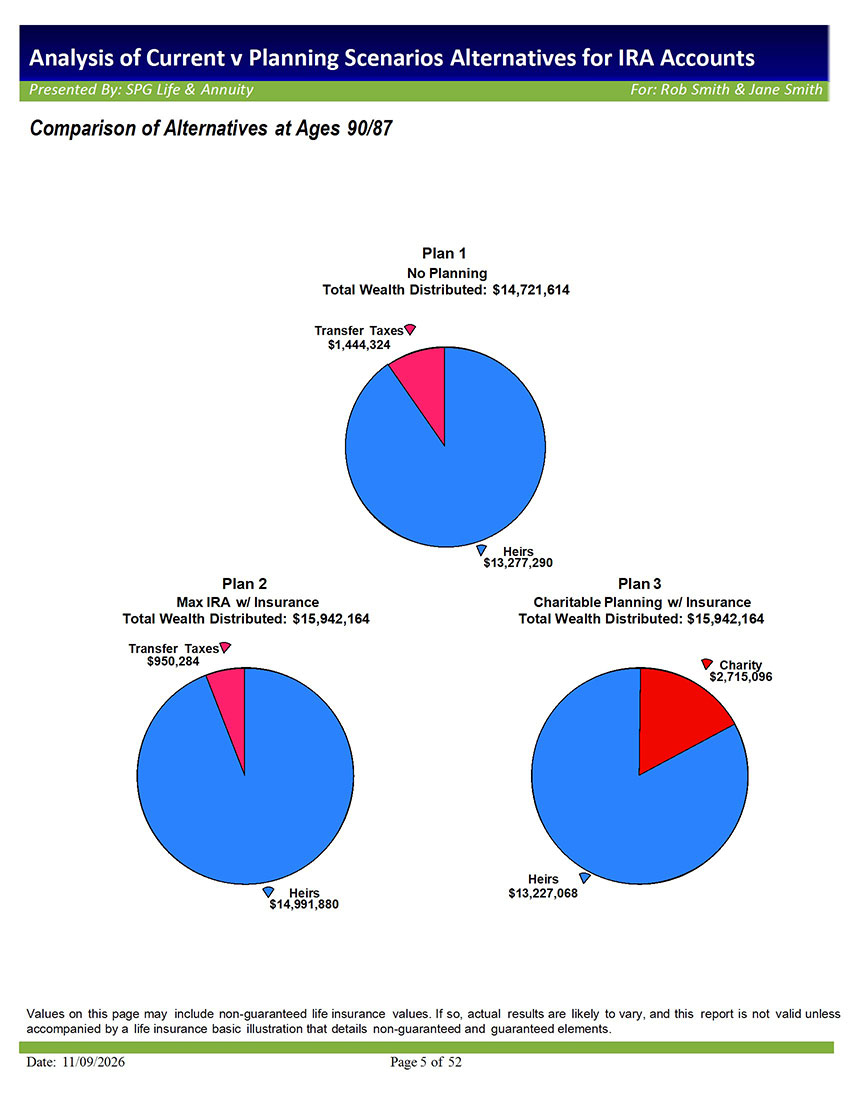
At Jane's life expectancy of 87, the children receive $1.7 million more. There is no charity in this plan. The tax-free death benefit replaces the IRA, and the income tax due on the IRA at death falls from $1,444,324 to $950,284.
“Won't accelerated distributions cost the couple more tax?” This is the most common objection. It is a fair concern, so show it.
| Jane's Age at Second Death | Couple's Tax During Life, Plan 1 | Couple's Tax During Life, Plan 2 | Total IRA Income Tax, Plan 1 | Total, Plan 2 | Total, Plan 3 |
|---|---|---|---|---|---|
| 84 | $1,175,541 | $1,216,423 | $2,764,812 | $2,262,074 | $1,216,423 |
| 87 | $1,534,280 | $1,452,453 | $2,978,604 | $2,402,737 | $1,452,453 |
| 90 | $1,918,705 | $1,705,383 | $3,166,796 | $2,526,557 | $1,705,383 |
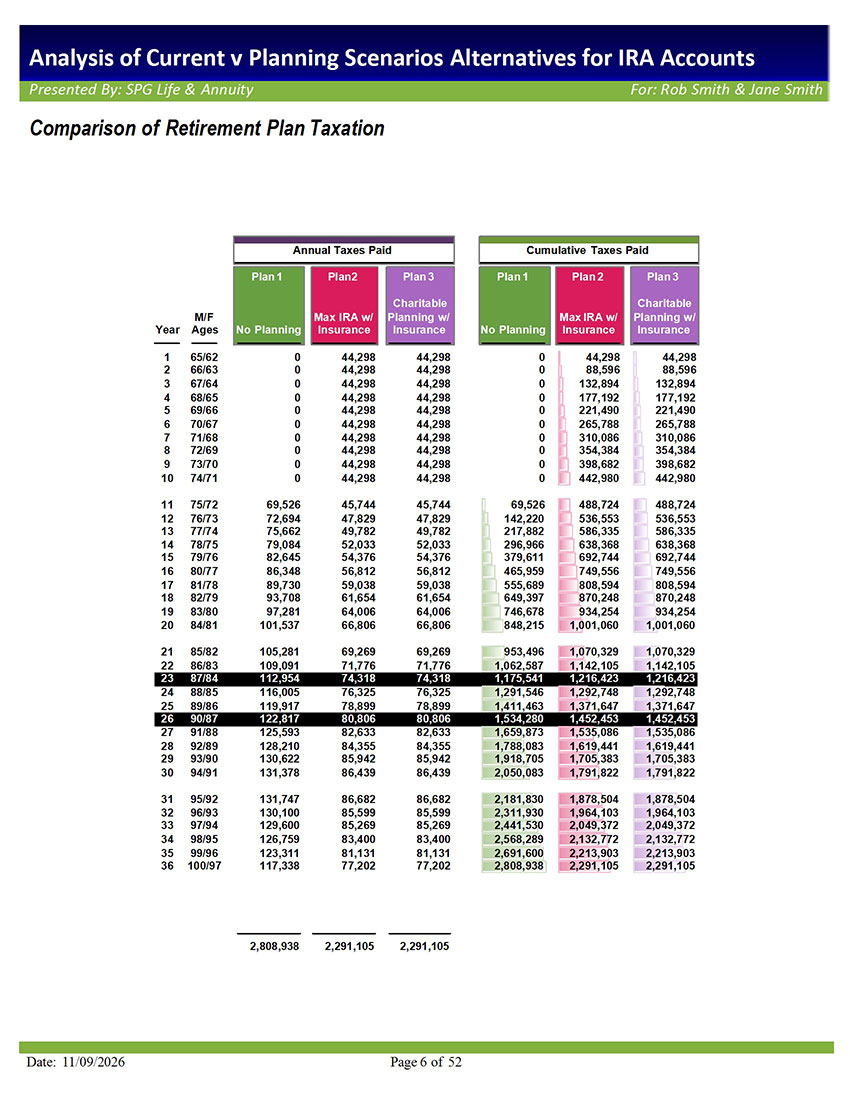
The objection is right about the early years. The couple's extra cumulative tax peaks at $442,980 in year 10, when Rob is 74. After that Plan 1 begins paying RMD tax and the gap narrows every year. It is $40,882 when Jane is 84, and it reverses at 86. By Jane's 87, the couple has paid $81,827 less in Plans 2 and 3 than in Plan 1. Across both generations, the income tax on the IRA is $575,867 lower in Plan 2 and $1,526,151 lower in Plan 3 at 87.
The income tax doesn't disappear in any plan. In Plans 2 and 3 it is paid sooner, in smaller amounts, at rates the couple controls. The IRS is the only party worse off.
Put it to the client as a question: “Would you pay about $443,000 more tax during the first decade of retirement, a cost that disappears by your mid-80s, to keep $1.4 million of income tax at death from the IRS?”
What If the IRA Goes to a Family Donor Advised Fund? Plan 2 versus Plan 3
| At Jane's 87 | Plan 1: No Planning | Plan 2: Max IRA | Plan 3: Charitable |
|---|---|---|---|
| Children receive | $13,277,290 | $14,991,880 | $13,227,068 |
| Family Donor Advised Fund (children advise grants) | $0 | $0 | $2,715,096 |
| Total children receive and direct | $13,277,290 | $14,991,880 | $15,942,164 |
| Income tax due on the IRA at death | $1,444,324 | $950,284 | $0 |
| Lead over Plan 1 | +$1,714,590 (+12.9%) | +$2,664,874 (+20.1%) |
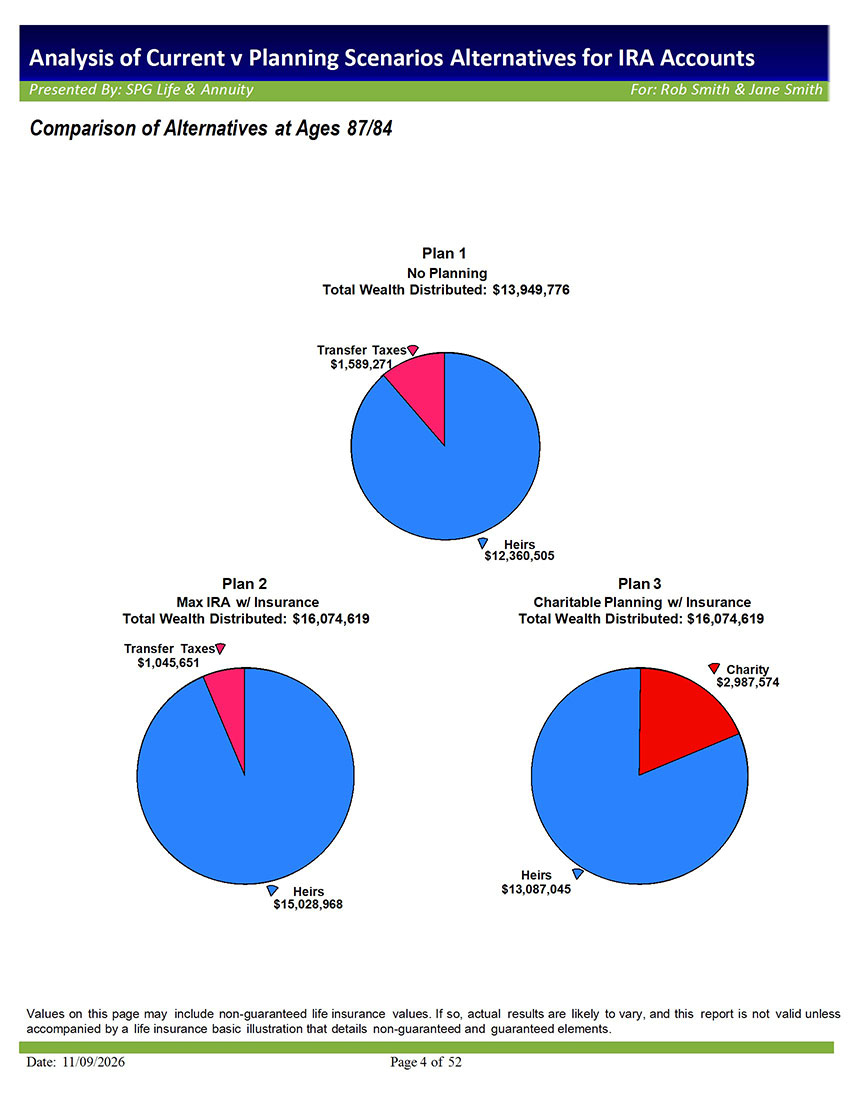
One beneficiary change moves the IRA to a family Donor Advised Fund. The children receive $13,227,068, which is $50,222 (0.4%) less than Plan 1, and a $2.7 million family legacy is added. Survivorship coverage is what makes that possible, because the policy pays at the second death, exactly when the IRA's tax burden reaches the children.
Moving the IRA from Plan 2 to Plan 3 costs the children $1,764,812 and funds $2,715,096. Every $1.00 sent to the family Donor Advised Fund costs the children $0.65, at every age. That is exactly one minus the 35% rate, so it is a model result. The children give up 65 cents of after-tax IRA value to move a full dollar to the Donor Advised Fund. That is disinheriting the IRS in one line.
Two cautions. The DAF is irrevocably charitable, so the family advises grants but does not own the assets. And its balance is the IRA at the second death, drawn down by RMDs, so it is a legacy at death and not a guaranteed endowment.
Control Stays With the Survivor
Rob owns the IRA while he is alive. At his death, Jane rolls it into her own name and controls the beneficiary designation until she dies. Naming the DAF is a beneficiary designation, not a gift, so she can change it at any time. The structure is spouse as primary beneficiary and the DAF as contingent, so the choice between Plan 2 and Plan 3 stays open until the second death.
The flexibility has limits. The designation is revocable, but the premiums paid and the tax on the accelerated distributions are not. Spousal consent applies to ERISA plans and in community property states, divorce decrees can restrict changes, and the survivor should give an agent express authority over beneficiary designations in her power of attorney. Review the designation annually.
What If They Live Longer? The Scenario Every Client Should See
A good scenario tool also shows the case you'd rather not. Here is the same comparison at later second deaths.
| Jane's Age at Second Death | Plan 1: Children | Plan 2: Children | Plan 3: Children | Plan 3: DAF | Plan 2 vs. Plan 1 | Plan 3 Children + DAF vs. Plan 1 |
|---|---|---|---|---|---|---|
| 84 | $12,360,505 | $15,028,968 | $13,087,045 | $2,987,574 | +$2,668,463 | +$3,714,114 |
| 87 | $13,277,290 | $14,991,880 | $13,227,068 | $2,715,096 | +$1,714,590 | +$2,664,874 |
| 90 | $14,249,976 | $14,831,951 | $13,306,915 | $2,346,210 | +$581,975 | +$1,403,149 |
- The advantage narrows each year after 84. The family-level lead falls from $3.7 million at Jane's 84 to $1.4 million at 90. By about Jane's 92 or 93 the comparison reverses, as the full run to 100/97 in the report shows.
- The cause is arithmetic, not tax. The death benefit is level, the couple pays premiums for 36 years, and the assets they aren't drawing on in Plan 1 keep compounding.
- In Plan 3, the children's own share falls behind Plan 1 after Jane's 86. It is $943,061 behind (6.6%) at 90, which is the cost of the family Donor Advised Fund.
Wealthy and Wise+ lets the advisor move life expectancy and show the client exactly where the strategy stops winning. Showing that is what turns a product illustration into a planning recommendation.
Why Advisors Should Care
The scenarios fit a specific client:
- An IRA of $500,000 or more.
- Age 59½ or older.
- No need for the IRA to fund their lifestyle.
Roth conversions and Qualified Charitable Distributions are excellent tools. This architecture is the second half of the conversation for that client.
There is a business case too. QCDs, capped at $111,000 for 2026, leave the advisor's management the day they are made and cannot fund a DAF. Many DAF sponsors allow advisor-managed accounts, so the charitable dollars can stay under management for another generation.
Most important, the conversation starts with purpose, not product: what the couple want their wealth to accomplish, for whom, and on what terms. In my experience, plans fail more often from ambiguity and unspoken family dynamics than from taxes or markets.
Building It in Wealthy and Wise+
- Plan 1: Fund retirement plan assets at the minimum distribution unless more is needed.
- Plans 2 and 3, distributions: Use a Special Distribution Schedule that nets the premium after tax, then distributions as needed.
- Plans 2 and 3, insurance: Enter the premium as Dedicated Cash Flow and the survivor death benefit as Other Assets Inside the Estate.
- Plan 3, charity: Direct 100% of the defined contribution plan as a charitable bequest.
- Travel and living expenses: Index them identically in all three plans.
- Reports: Run the Comparison of Alternatives at the survivor's life expectancy and at the ages around it.
Link to the full Wealthy and Wise+ evaluation Rob & Jane Smith (InsMark Blog).pdf
Conclusion
At Jane's life expectancy of 87, three decisions changed this couple's outcome. A distribution schedule and a $6.45 million survivorship policy put $1.7 million more in the children's hands. One beneficiary designation then turned $1.4 million of IRS income tax at death into a $2.7 million family Donor Advised Fund, with the children receiving about what they would with no planning. The couple's lifestyle never changed. The advantage narrows steadily and is gone by about Jane's 92 or 93, and the advisor should show the client exactly where.
None of this required a new product. It required asking “what if” and showing the answer.
So ask the question and let the client decide: would they rather pay the tax, or have their children pay it?

Important Note #1: The hypothetical life insurance illustrations and investments referred to in this Blog assume the nonguaranteed values shown continue in all years. This is not likely, and actual results may be more or less favorable. Actual illustrations of life insurance are not valid unless accompanied by a basic illustration from the issuing life insurance company. Guarantees are subject to the claims-paying ability of the issuing company.
Important Note #2: The information in this Blog is for educational purposes only. In all cases, the approval of a client's legal and tax advisers must be secured regarding the implementation or modification of any planning technique and the applicability and consequences of new cases, rulings, or legislation upon existing or impending plans. State income, estate, and inheritance taxes are not reflected. Donor Advised Fund sponsors vary in their beneficiary designation procedures, investment options, and grant policies.